
Dining & Events / Guide 09
Hospitality Interior Design Abu Dhabi: Breakfast Buffets with Clear Guest Routes
Organise an Abu Dhabi hotel breakfast buffet with intuitive stations, space for waiting, discreet replenishment and a flexible dining-room layout.
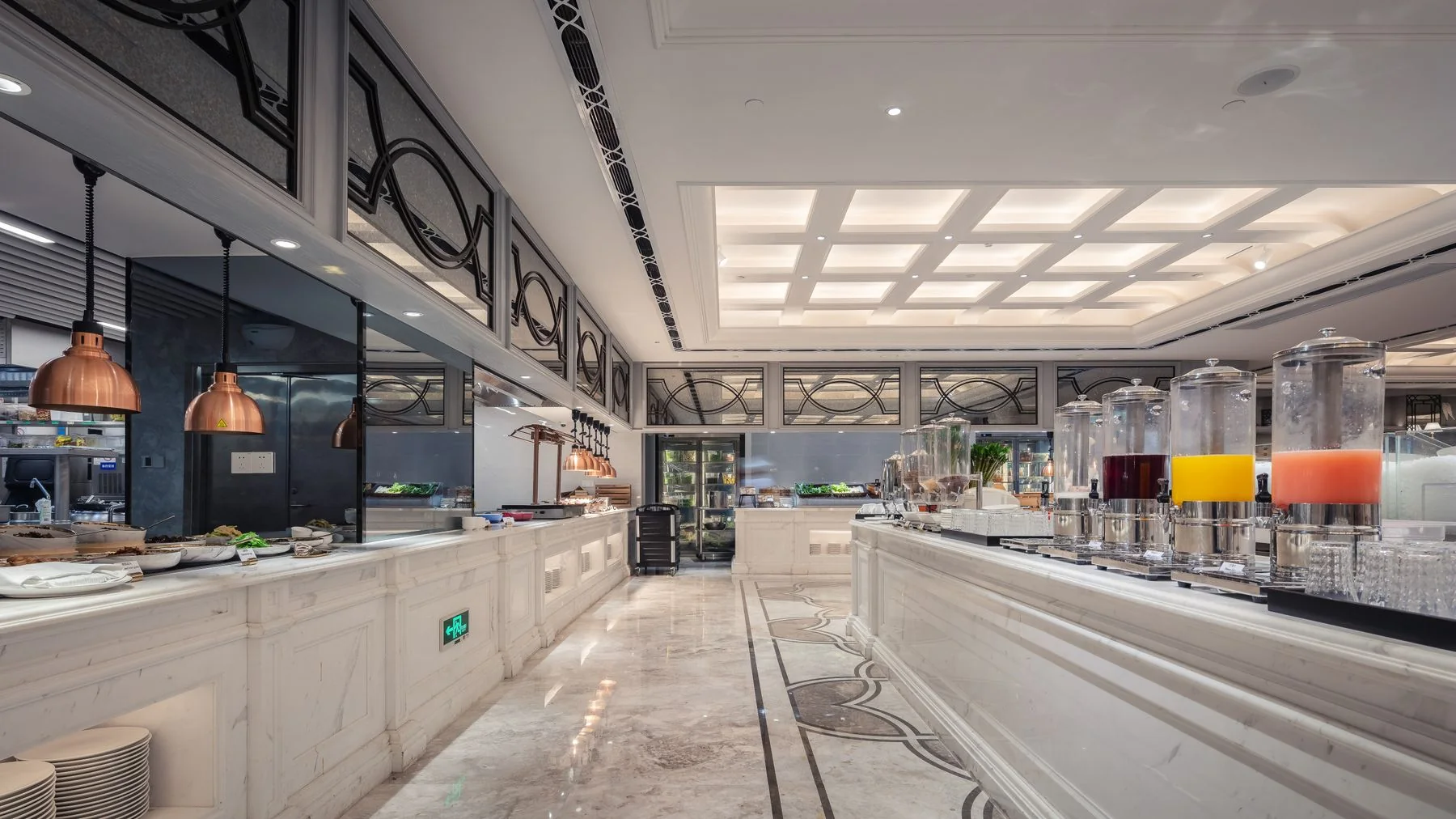
At a glance
Design a breakfast buffet around the guest's decision sequence and the team's replenishment route. Separate high-demand stations where appropriate, make plates and information easy to find, and keep queues out of the dining aisles. Coordinate equipment and food-service requirements before specifying counters.
Breakfast concentrates many small decisions into a busy part of the hotel day. Guests look for a table, a plate, familiar food and a drink while staff replenish and clear around them. Hospitality interior design in Abu Dhabi should help this activity feel intuitive, with a layout that supports different routines without requiring a long line of instructions.
Understand how breakfast is served
Confirm whether guests choose a table first, wait to be seated or move directly to the buffet. Establish which items are self-service and which are ordered. These choices affect the relationship between the entrance, host position, food displays and tables.
Observe or model the expected busy period rather than planning for an average empty room. Families, solo travellers and groups may arrive at different speeds and spend different amounts of time choosing. Include staff carrying hot drinks and clearing dishes when reviewing the movement pattern.
Break up predictable bottlenecks
A single continuous counter can make everyone queue behind the slowest decision. Consider separating a popular drinks point or cooked-to-order station when the service model and available space support it. Keep the arrangement legible so guests do not have to cross the whole restaurant repeatedly to assemble a simple breakfast.
Place plates and other essentials where they support the intended starting points. If several stations can be approached independently, a single distant stack of plates may undo that flexibility. Test the route with a tray, a cup and a companion beside the guest.
Coordinate displays with equipment
Agree the menu and equipment strategy with the operator and foodservice specialist. Refrigerated, heated and ambient displays have different technical and operating needs. Counter appearance, power, ventilation, drainage and access should be resolved together, with food-safety procedures established by the responsible team.
Avoid treating equipment as an item placed into an already finished decorative enclosure. Check lids, service panels and the space needed for staff to replace containers. The buffet should remain workable after protective screens, utensils, labels and everyday accessories are added.
Make information easy to use
Provide clear, consistent labels positioned close to the relevant food, where they can be read without leaning across the display. Coordinate dish names, dietary information and language requirements with the operator. Do not rely only on a decorative icon or colour to communicate information that guests may need to confirm with staff.
Light the food and labels without creating strong reflections on glass or polished counters. Check the view for shorter guests and seated users. An attractive display loses value if the contents and information are difficult to see.
Plan replenishment and the next service
Give staff a practical route to replenish without repeatedly crossing the busiest guest approach. Identify temporary landing space and the route for used containers. Where the room serves lunch or dinner later, decide how buffet equipment is concealed, removed or repurposed and where movable pieces are stored.
- Test the busiest station with several guests waiting at once.
- Keep buffet queues clear of dining chairs and main routes.
- Confirm that service panels remain accessible after installation.
- Document the breakfast-to-lunch changeover with the operations team.
Common questions
Is an island buffet better than a wall counter?
Neither is universally better. An island can offer several approaches but needs circulation on multiple sides. A wall counter can simplify servicing but may create a longer queue. Test the actual room and menu.
Can a breakfast buffet be used as a dinner feature?
Yes, if its equipment, lighting and storage are planned for that change. Confirm what remains visible, where unused items go and how staff can reset the area without disrupting guests.